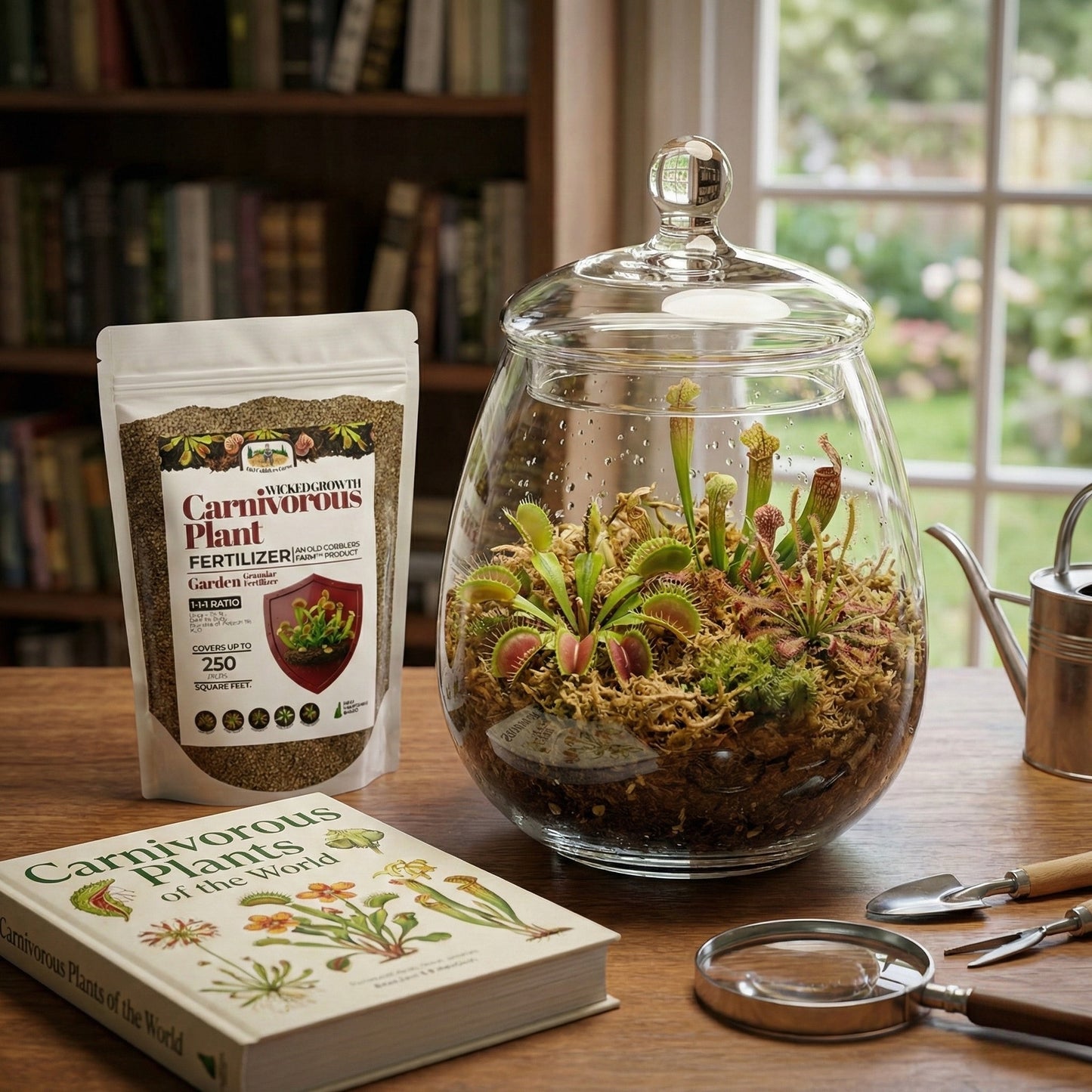
Wicked Growth Carnivorous Plants Fertilizer
Wicked Growth Carnivorous Plants Fertilizer
Couldn't load pickup availability
Product Description
Product Description
Feed Without Interfering — A Minimum-Strength 1-1-1 Formula for Carnivorous Plants
Old Cobblers Farm Wicked Growth 1-1-1 is a minimum-strength plant food made for the most nutrient-sensitive plants in cultivation: carnivorous plants. Venus flytraps, pitcher plants, and sundews evolved in nutrient-poor bogs and get most of their nutrition by catching insects — which is exactly why typical fertilizer strengths overwhelm them. The 1-1-1 analysis supplies just 1% each of nitrogen, phosphorus, and potassium: a trace-level supplement, diluted further to ¼ teaspoon per quart of distilled water before it ever touches the plant.
This is a complement to natural feeding, not a replacement for it. Plants that are actively catching insects may need very little supplemental feeding at all; the formula exists for indoor and terrarium plants that rarely see prey, and for supporting steady growth through the active season. Used as a light foliar mist every 2–4 weeks during spring and summer — and never during dormancy — it provides gentle support while leaving the plant's natural trapping behavior to do its job.
Key Benefits
Minimum strength by design — At 1% each of N, P, and K — diluted again to ¼ teaspoon per quart — feeding stays at the trace levels bog-evolved plants are adapted
Works alongside the traps, not instead of them — A light foliar mist supplements nutrition without involving the sensitive roots or interfering with the traps doing their work.
For indoor plants that can't hunt — Made for the plants that rarely see prey: terrarium and windowsill flytraps, indoor Nepenthes, and greenhouse collections.
The whole carnivorous collection — One formula for flytraps, pitchers, sundews, butterworts, bladderworts, and cobra lilies.
A tiny amount goes a very long way — A few grams dissolves into quarts of feed — roughly 24 doses per ounce of product.
Guardrails included — The instructions build in every carnivorous-plant rule: distilled water only, sparing use, and a hard stop during dormancy.
Where to use it: terrariums, bog gardens, windowsill collections, and greenhouses growing Venus flytraps (Dionaea muscipula), pitcher plants (Sarracenia, Nepenthes, Cephalotus), sundews (Drosera), butterworts (Pinguicula), bladderworts (Utricularia), cobra lilies (Darlingtonia californica), and other tropical carnivorous species.
Application Instructions
Application Instructions
Foliar feeding (preferred):
1. Dilute ¼ teaspoon in 1 quart of distilled water and mix until fully dissolved.
2. Mist lightly onto the foliage every 2–4 weeks during active growth (typically spring and summer).
Soil feeding (optional):
1. If a plant is not regularly catching insects, apply 1–2 drops of the diluted solution near the base every 4–6 weeks.
When and how often: feed sparingly, only during active growth. Do NOT fertilize during dormancy — typically fall through winter for temperate species like Venus flytraps and Sarracenia.
What NOT to do: never exceed ¼ teaspoon per quart, never use tap water, never apply dry product to soil or foliage, never feed a dormant plant, and don't treat this as a substitute for the plant's own insect-catching.
Ingredients
Ingredients
A specialized, low-analysis nutrient source providing a gentle, balanced 1:1:1 ratio of nitrogen, phosphorus, and potassium for steady growth without overwhelming sensitive root systems. Formulated specifically to supplement highly sensitive carnivorous plants — pure, trace-level performance and gentle seasonal support.
Product Specifications
Product Specifications
– Nitrogen (N): 1%
– Phosphorus (P): 1%
– Potassium (K): 1%
– Total Nutrients: 3% total analysis
– Form: Granular
– Doses: Approx. 24 quarter-teaspoon doses (≈24 quarts of feed) per ounce of product
– Application Rate: ¼ tsp per quart of distilled water
– Feeding Schedule: Foliar mist every 2–4 weeks in active growth; optional 1–2 drops at the base every 4–6 weeks for plants not catching insects; never during dormancy
– Water Requirement: Distilled, reverse-osmosis, or rainwater ONLY
Share