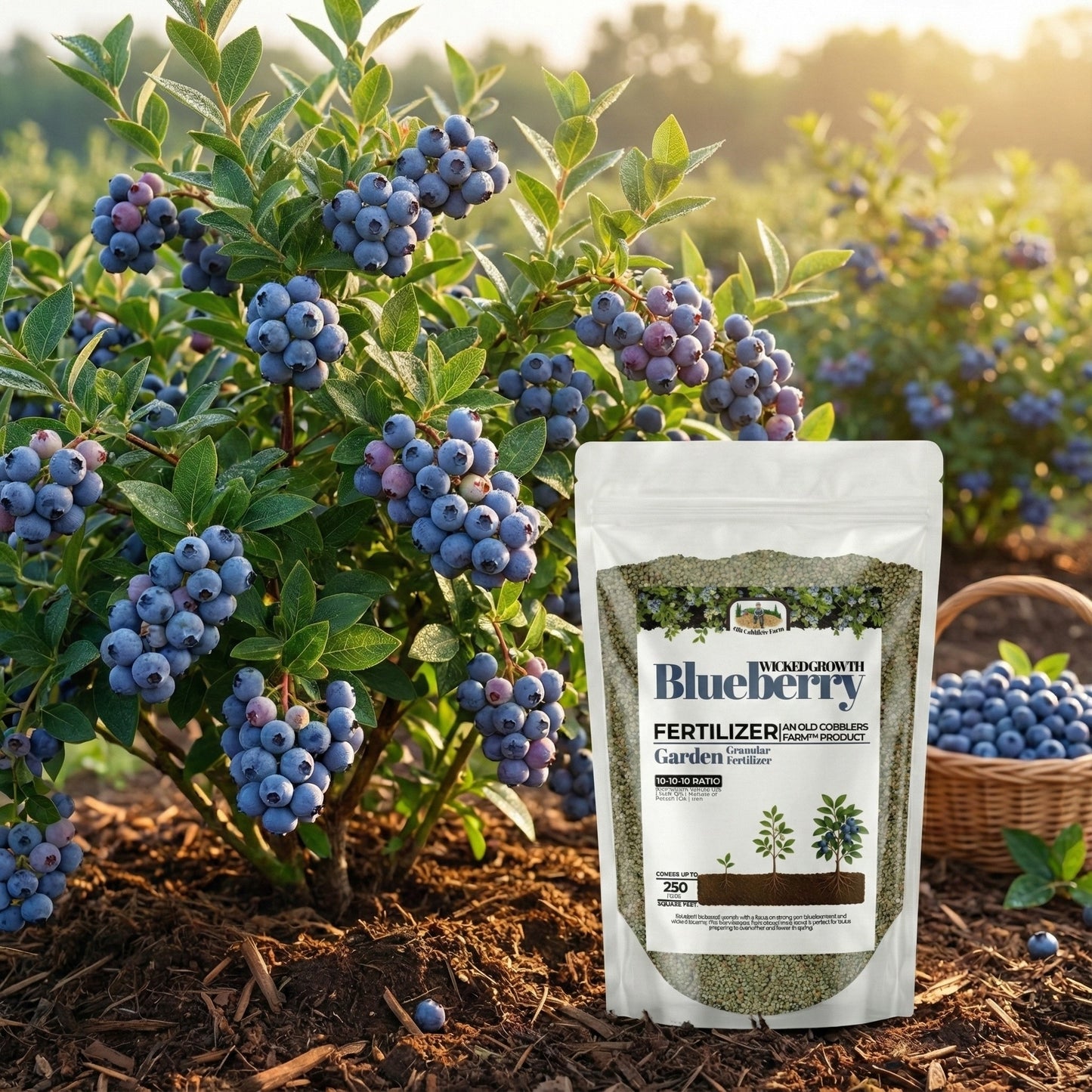
Wicked Growth Blueberry Fertilizer
Wicked Growth Blueberry Fertilizer
Couldn't load pickup availability
Product Description
Product Description
One Early-Spring Feeding, A Summer of Blueberries — Balanced 10-10-10
Old Cobblers Farm Wicked Growth 10-10-10 is a balanced fertilizer for blueberry bushes. The 10-10-10 analysis supplies equal parts of the three major nutrients: 10% nitrogen for healthy canes and foliage, 10% phosphorus for root development and fruit bud support, and 10% potassium for bush resilience and berry quality.
Blueberries have one feeding habit and one soil demand. The feeding habit is simple — a measured early-spring application of 1–2 cups per bush, spread at the drip line as buds begin to swell. The soil demand is the part most growers miss: blueberries require acidic soil, around pH 4.5–5.5, to take up nutrients at all. This fertilizer feeds; it does not acidify. If a soil test shows your pH is too high, add elemental sulfur separately to lower it — otherwise the bushes can sit in well-fed soil and still show pale, yellowing leaves because they can't access what's there.
Key Benefits
Balanced for the bush — Equal 10-10-10 nitrogen, phosphorus, and potassium support canes, roots, fruit buds, and berry quality in one early-spring feeding.
A once-a-year habit — One measured application as buds swell carries the bush into the season — 1 cup for smaller bushes, 2 for mature ones.
Drip-line targeting — Spreading at the drip line puts nutrients over the feeder roots, away from the shallow crown blueberries are known for.
Honest about pH — The instructions lead with what actually limits most blueberry plantings: soil pH. Test first, add sulfur separately if needed, then feed.
Every backyard blueberry — Highbush, half-high, rabbiteye, and lowbush varieties in home gardens and berry patches.
Sized for the home patch — A 5 lb bag feeds roughly 6–11 bushes per application.
Where to use it: home gardens and berry patches growing highbush, half-high, rabbiteye, and lowbush blueberry varieties, in beds and rows.
Application Instructions
Application Instructions
Steps:
1. Test your soil first. Blueberries need pH roughly 4.5–5.5; if your pH is higher, apply elemental sulfur separately (per the sulfur product's label) to lower it — this fertilizer does not change pH.
2. In early spring, as buds begin to swell, measure 1–2 cups for the bush's size.
3. Spread evenly at the drip line — the circle on the ground under the outer branch tips — keeping granules away from the crown and stems.
4. Work lightly into the soil surface (or through the mulch) and water thoroughly.
When and how often: once, in early spring. Avoid late-season feeding so canes harden off before winter.
What NOT to do: do not exceed the per-bush rates, do not pile granules against stems or the crown, do not expect this product to fix soil pH, and do not skip the watering-in step.
Ingredients
Ingredients
-Monoammonium Phosphate (10–20%) — Also called MAP; supplies phosphorus for roots and fruit bud support, plus a secondary nitrogen contribution.
-Potassium Chloride (40–50%) — Also called muriate of potash; the potassium source for resilience and berry quality.
Product Specifications
Product Specifications
– Nitrogen (N): 10% — 0.5 lb per 5 lb bag
– Phosphorus (P): 10% — 0.5 lb per 5 lb bag
– Potassium (K): 10% — 0.5 lb per 5 lb bag
– Total Nutrients: 1.5 lb per 5 lb bag (30% total analysis)
– Form: Granular, fast-acting
– Coverage: Feeds approx. 6–11 bushes per application, depending on bush size
– Application Rate: 1–2 cups per bush, spread at the drip line
– Feeding Schedule: Once, in early spring as buds swell
– Soil pH Requirement: 4.5–5.5 (acidic) — maintain with elemental sulfur applied separately; this product does not acidify
Share